 Every article and news report on the European crisis seemed to mention the ‘EFSF’ – the European Financial Stability Fund. What is it and why is it important?
First things first, what is it?
Officially, Its a triple A-rated eurozone private company run by the European Commission, European Central Bank, IMF and the Eurogroup (eurozone finance ministers). It is backed by guarantees from all 17 eurozone countries (but really, its the guarantees of the 6 AAA ones that matter). It sells debt/bonds to raise money for bailout funds for countries in need and help them pay their short term debts (keeping the default wolf from the door). It can also be used by a country to fix their banking sector (as in Ireland). But it cant just intervene. Countries must apply for funds and be accepted (so you better be in trouble because ‘applying’ is enough to make investors run for the hills). So it’s a means to an end – only to be used after euro-using countries cant borrow in the normal way from the markets.

How much is it?
Before reform proposals made in July are agreed, it has a ceiling of €250bn. Of this, €100-€135bn has been pledged to Greece (€25bn for 1st bailout + €72bn-€110bn for 2nd bailout), Ireland (€17.7bn) and Portugal (€26bn). The July 21 reforms will see its lending ceiling grow to €440bn. Even if the reforms are passed by October across the EU, the pot is already reduced to between €260-€300bn after PIG deductions. If you want to get technical, because EFSF bonds are guaranteed up to 165% of their size, the EFSF crutch (on remaining funds) is technically between €429-€495bn. In cold hard cash, the overall bailout fund, adding the EU’s €60bn and IMF’s €250bn is now between €570-€610bn.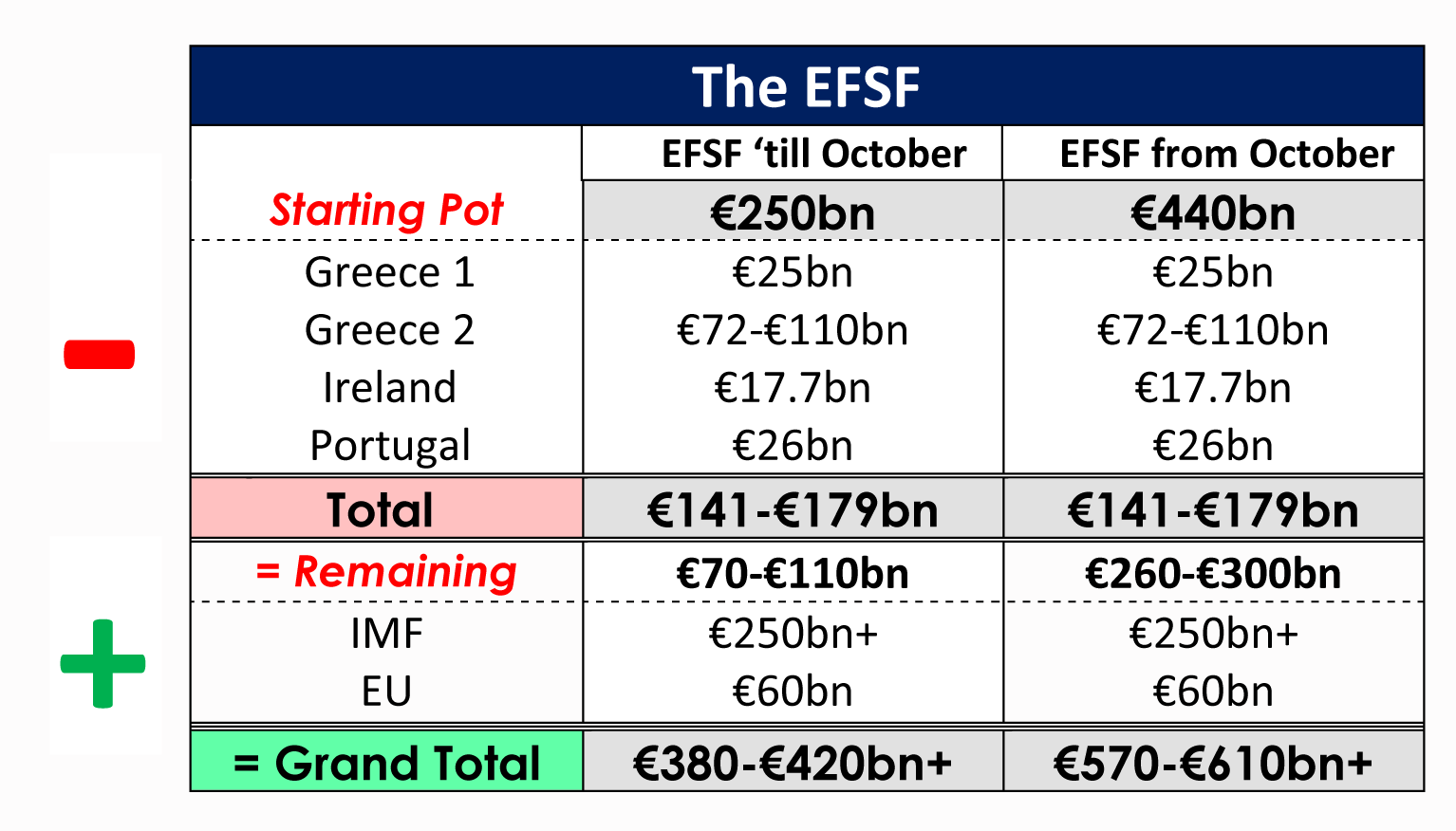


 Posted by Editor





 piigsty