Economics 101 (#21) Capital and Interest

December 1, 2011

The 3rd Factor of Production (FOP) we’ll go through is Capital (and the reward for providing it, interest). Capital is defined as anything made by man and used in the production of goods/services

Heres the PDF PIIGSTY Econ 101 #21 Capital and Interest Rates


How do interest rate changes affect the wider economy?


Economics 101 (#20) Labour and Wages

December 1, 2011

The 2nd Factor of Production (FOP) we’ll go through is Labour (and the reward for providing it, wages). Labour is defined as any human effort which goes into the production of goods/services.

Heres the PDF PIIGSTY Econ 101 #20 Labour and Wages


Economics 101 (#19) Land and Rent

December 1, 2011

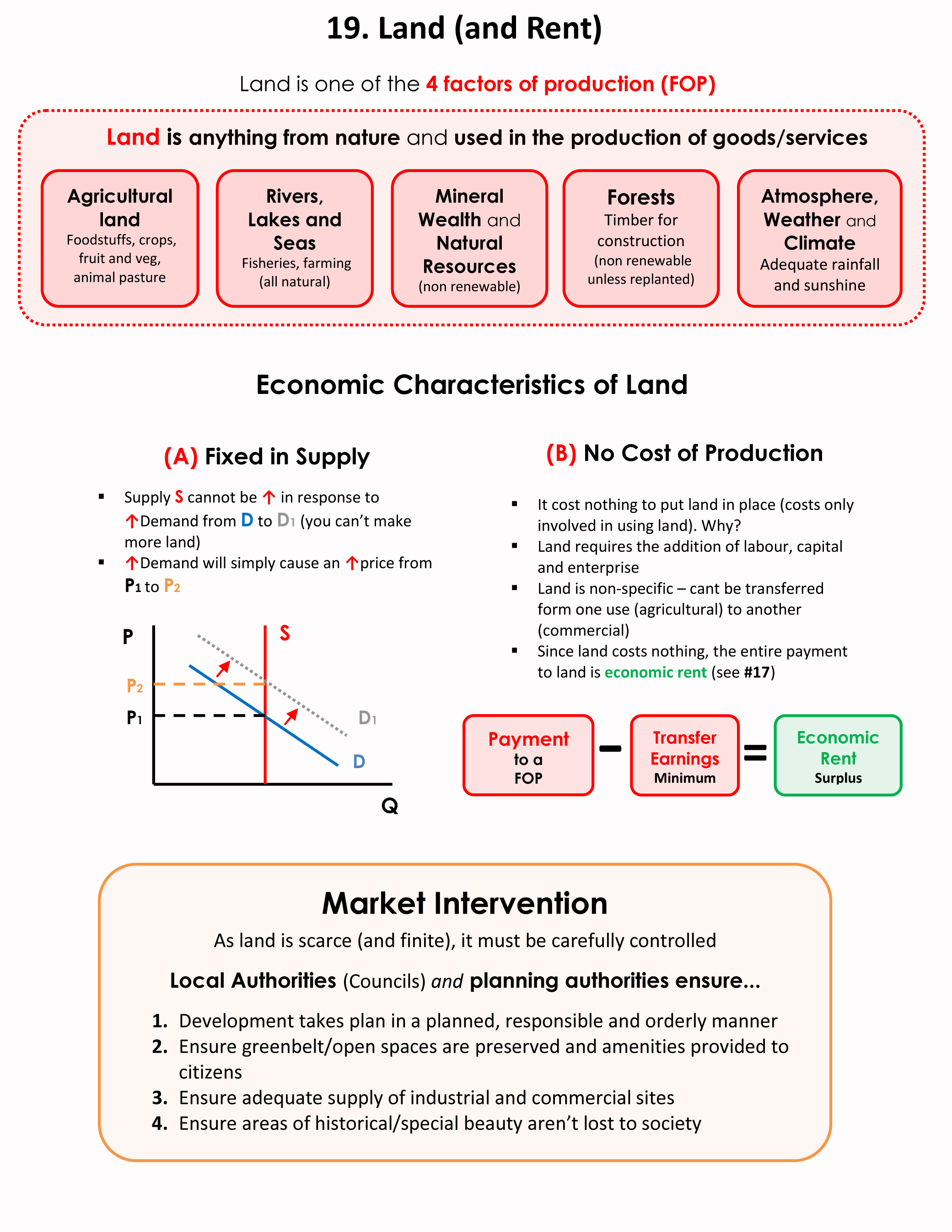
The 1st Factor of Production (FOP) we’ll go through is Land (and the reward for providing it, rent). Land is defined as anything supplied by nature and used in the production of goods/services i.e. forests, farmland, rivers, seas and mineral wealth.

Heres the PDF PIIGSTY Econ 101 #19 Land and Rent


The ECB fiddles as Rome Burns? The Role of the ECB in the European Crises

November 18, 2011

Unquestionably, the role of the European Central Bank (ECB) in the European debt crisis is paramount but its often misunderstood. Arthur Beelsey in the Irish Times paints an excellent picture “Brooding like a colossus in the centre of the fray stands the European Central Bank, an innately conservative institution that has ditched one sacred cow after another in the chaotic struggle to calm the disruption.” ‘Conservative’ is code word for keeping a very tight grip on the money supply so to keep European exports strong. Problem is – you can’t always have price stability and full employment (they’re two conflicting policy goals, in a normal economic situation). Manipulating the economy, especially one as diverse as the eurozone-17,  is an extremely delicate process which European Central bankers tend to be very cautious about.

The ECB (which the Germans hold the strongest cards) has always assiduously adhered to the model on which it was based – the German Central Bank or Bundesbank- and as such has remained committed to an ‘overseer’ policy of strict price stability (and restricting its functions to setting interest rates) rather than intervening in the market to reduce the volatility of those boom-bust cycles, such as is practiced by the US Federal Reserve. However, its preferred non-confrontational, dormant, staid and strictly collective role overseeing the cautious monetary policy of the eurozone-17 bloc has been changed hugely by various crises in which component nations, notably the PIIGS, find themselves engulfed with.

Article 23 of the ECB statute says that “the ECB may conduct all types of banking transactions in relations with third countries and international organizations, including borrowing and lending operations.”

This effectively rules out the ECB directly intervening in buying sovereign debt from countries under law but it DOES NOT rule out the ECB buying debt indirectly (from secondary sources) including pension funds, European banks etc if the whole point of doing this is to keep the eurozone monetary policy flowing. So its fair to say that a new ECB policy of roundabout intervention in the markets to quell the current crises is a doctrine that many are fundamentally opposed. The controversial policy of ‘printing money’ or quantitative easing, as practiced by the Bank of England, the US Federal Reserve and others, is an absolute non-starter for inflation weary ECB officials.

But the ECB has been forced into a bit of a U-turn (and a sort of compromise). After all, it is the responsible Central Bank for the eurozone at a time where commentators appear to be endorsing the collapse of the euro or, at the very least, its fragmentation back into competing national currencies and a ‘return of national sovereignty’. In the meantime, stung by inaction, wealthy PIIGS citizens withdraw billions from PIIGS banks leaving respective governments (and the ECB) to step in to prop them back up. Its a self defeating spiral.

The ECBs Bond Buying Initiative

The credit crunch and the ensuing banking crisis changed everything. For the first time, it appeared that the growth of the European economy would be severely dented and a recession, which appeared preventable, would hit hard. European banks were far too endemic in the European economy and their collapse was unfathomable.

  • August 2007/September 2008: ECB pumps money into European banks. After the collapse of Lehman Brothers in September 2008, ECB provides European banks with cheap loans to improve credit and short term funding availability in the eurozone as the interbank market seizes up.
  • May 2010 : €100bn-€110bn 1st Greek bailout sees the ECB, for the first time, get involved in the other crisis, that of sovereign debt by buying sovereign debt (bonds) on the secondary market to prop up Greek, Irish and Portuguese ‘at risk’ bond yields and avoid contagion
  • November 2010: Ireland requests a bailout with the controversial conditions attached whereby senior bondholders would be repaid in full.
  • February 2011: Head of the German Bundesbank  and member of the ECB Governing Council Axel Weber resigns in opposition to the continuing ECB bond buying programme
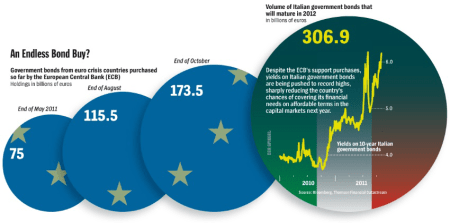
  • May 2011: Portugal requests a bailout. At this stage, the ECB bond buying programme to prop up Greek, Irish and Portuguese bond yields is clearly proven ineffective. ECB has bought a total of €75bn in bonds.
  • July 2011: €110bn 2nd Greek Bailout announced
  • August 2011: The ECB begins a similar action to buy Spanish and Italian bonds. ECB has bought a total of €115.5bn in bonds.
  • September 2011: German Jürgen Stark, member of the ECB’s Executive Board (considered ECB  ‘Chief Economist’) resigns citing disapproval at the ECB bond buying programme.
  • October 2011: Proposals to bolster the €440bn bailout fund via leveraging (rather than direct financial contributions) to €1tn announced along with a €130bn 3rd Greek Bailout. Markets remain unconvinced of the sustainability of PIIGS finances and national solvency with the ‘fluffy’ EFSF proposal. ECB has bought a total of €173.5bn in bonds.
  • November 2011: Amid soaring bond yields for Italy (and to a lesser extent Spain) IMF and eurozone officials discuss the idea of ECB lending to the IMF to bolster direct bailout funding to European nations in difficulty as earlier EFSF proposal failed to calm the markets. The level of ECB ‘cheap’ loans propping up the PIIGS banking systems is immense, at €180bn in Ireland alone.
IMF Involvement = More Radical Action?

In truth, more radical action is now inevitable, as this series of articles in Der Spiegel makes clear. The form of this action may be something unlike anything the Germans and the ECB ever wanted to contemplate, or it might mean outsourcing responsibility. So, who steps up? Its appears the IMF will, in two ways…

  • IMF supervision of national budgets and reform proposals in exchange for aid tranches
  • IMF becomes the European lender of last resort by issuing IOUs (and possibly bolstering the EFSF), rather than the ECB which never forecast that as its role (unlike national Central Banks).

Both of these ideas are hugely sobering ones for European technocrats and those supportive of the grand goals of the European project. Supervision of national budgets is effectively an admission of the inability of the European Commission to fulfill that function within the debt bloated PIIGS economies. Direct control of the eurozone debt crisis by the ECB in partnership with the IMF, shifts the onus for action onto the IMF. This might be a technical stroke by the ECB to avoid becoming entrenched in the debt crisis but it represents a clear admission of failure by European politicians in not being able to come up with a lasting, sufficiently funded compromise over the past 4 years. Either way, this equates to subordinating monetary policy to the IMF and running a dual IMF-ECB policy, potentially ruining the effectiveness of both. The Germans are understandably unlikely to support this.

The optics of the IMF effectively taking charge of an internal European crisis is a more destabilising factor for Europe than a mere debt crisis alone. Europe is destroying the very unity it has spent 60 years to carefully mould. By avoiding coming up with a comprehensive solution themselves (instead focusing on patchwork ‘sticking plaster’ solutions), the shift to the ECB and now, possibly, the IMF in Washington D.C. is hardly a shining example of European community action during times of adversity.


A Euro Crisis Here, A Euro Crisis There….

November 16, 2011

Europe has come a very long way from its early days where geopolitics and security concerns trumped pure commonsense economics (great oxymoron there!). PIIGSty is going to go out on a limb here and suggest that, if you strip away the hysteria and overreaction, Europe is more secure than it first appears. The problem in Europe isn’t necessarily the economics. Using the logic from a number of commentators, we have compared a number of European countries most featured in recent debate. The categories are:

  • High Risk: PIIGS – Portugal, Italy, Ireland, Greece and Spain
  • Moderate/Mid Risk: France and Belgium
  • Low Risk: Germany, Netherlands and the UK

Budget Deficits

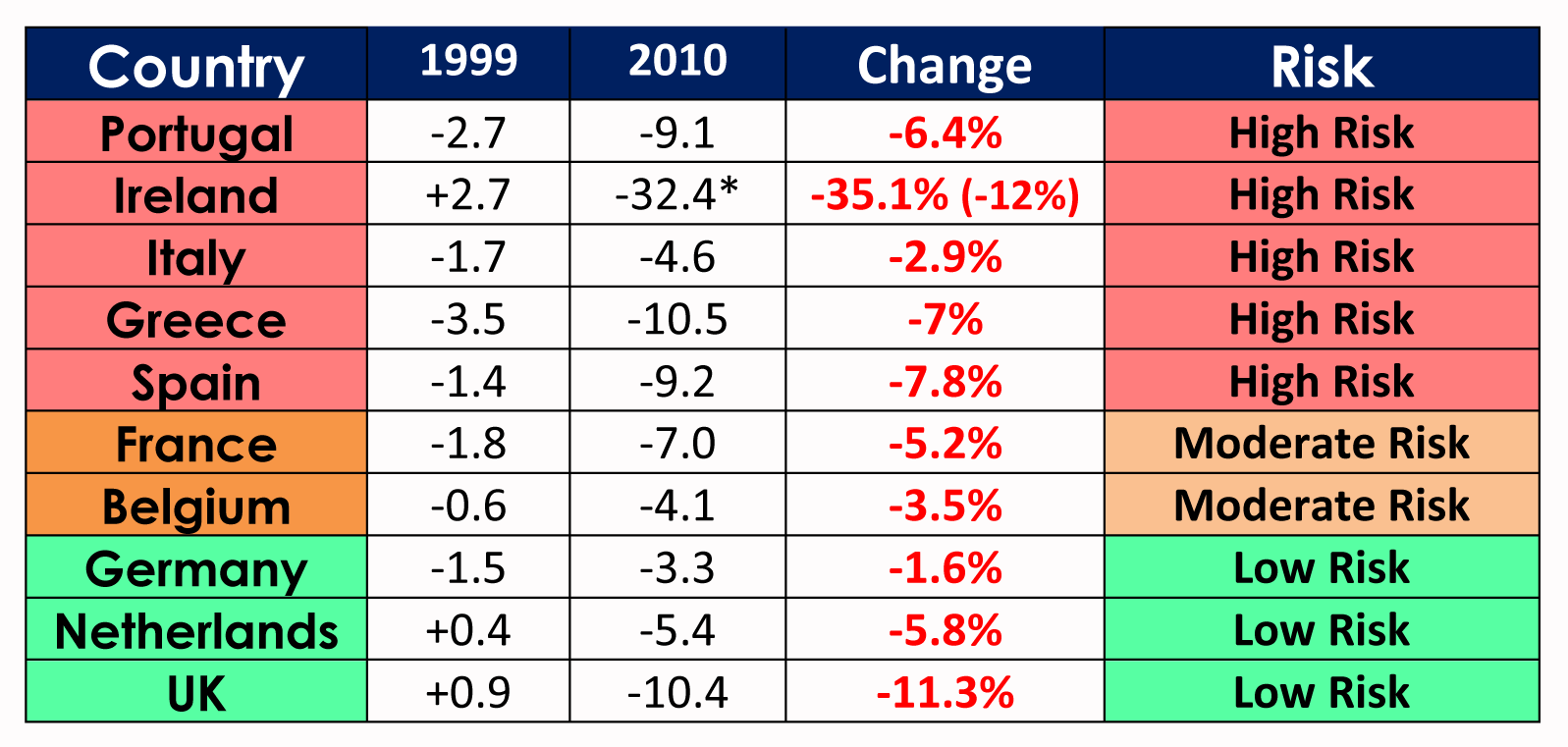
The correlation between the actual figures and the perceived ‘risk’ according to most commentators is puzzling at first glance. The following table outlines the change since the formation of the euro in 1999 (Greece having joined in 2002 and the UK a non-member for comparative sake).  The slide in budget balances give is uniform across the board. The PIIGS look like the worst offenders…but Italy (@ 2.9% change) looks quite stable. The erosion in the public finances in 2010 gives an insight into why Ireland, Greece and Portugal requested an EU-IMF bailout deal. Spain however, with a worse situation than all three, did not. Italy witnessed a moderate change from 1999  levels of less than 3%, similar to ‘moderate risk’ nations of France and Belgium. The Italian problem must lie elsewhere.

*The Irish figure amounted to a deficit of €50.3bn including an exceptional refinancing cost to prop up Anglo Irish Bank  of around €32bn-€34bn . Without this, the level would be about 12%

Debt: GDP

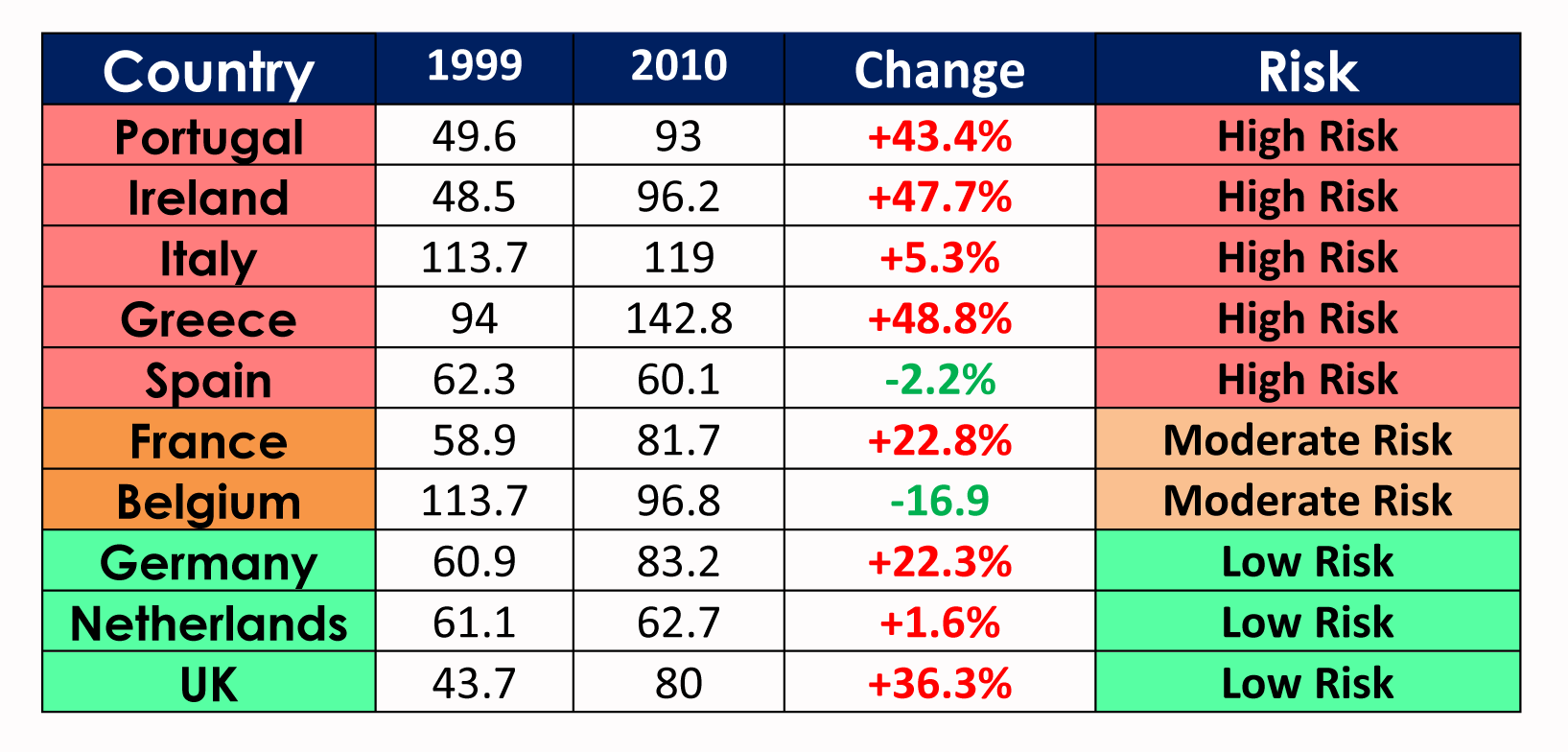
So, clearly the level of sovereign debt in the PIIGS is quite substantial. Ireland, Portugal and Greece (all EU-IMF bailout recipients) have increased their sovereign debt levels by almost identical levels since the formal creation of the euro in 1999.  Italy and Spain have very different (and more modest) results.

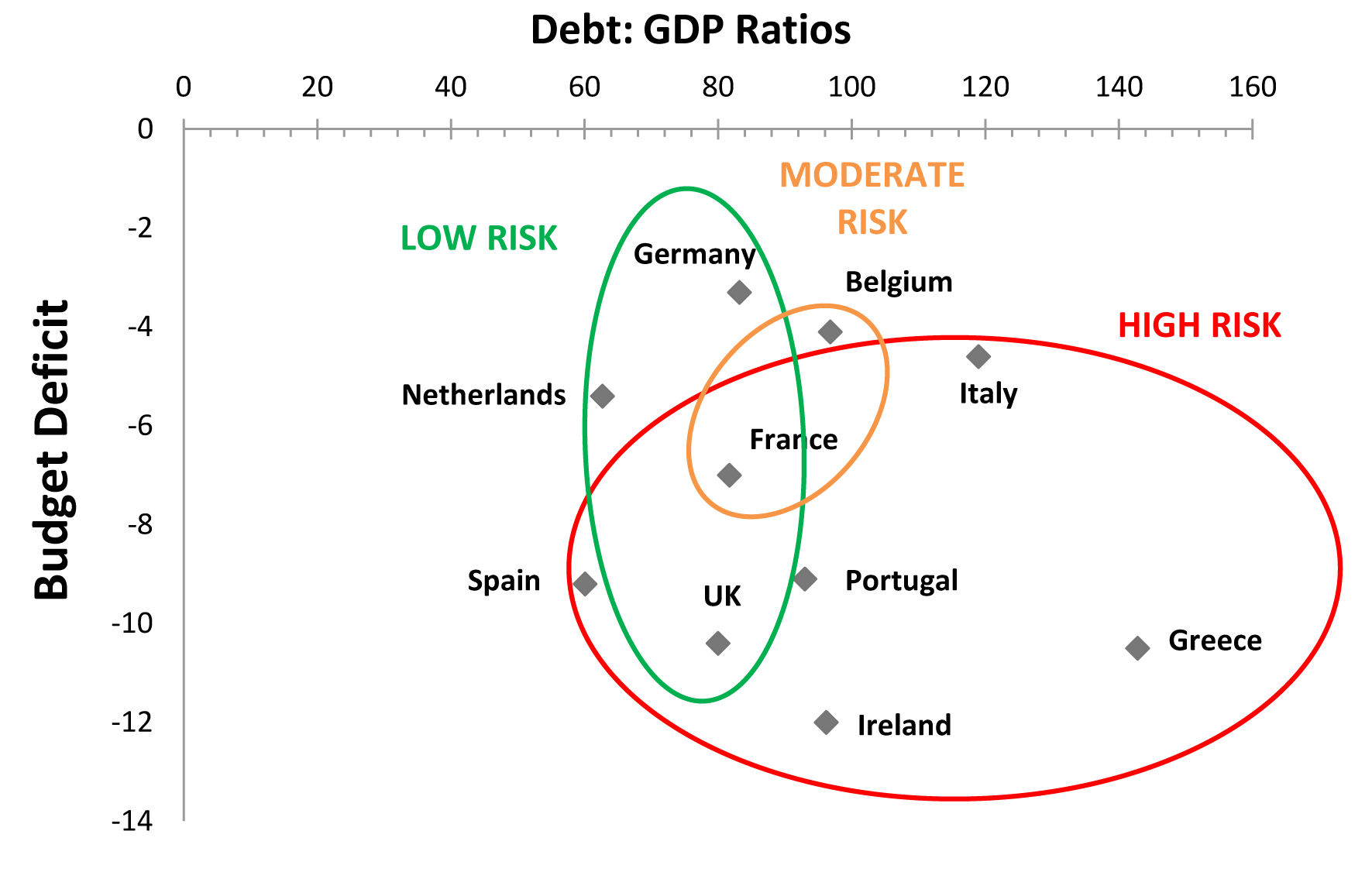
Putting all this together pictorially, we get…


Conclusion

The picture isn’t as straight forward as some commentators suggest. If its all about sovereign debt, then why is Italy suddenly a ‘panic’ problem when the level of debt has changed very little since 1999. Spain has even witnessed an improvement in its position since its entry into the euro.  Looking at budget deficits, its clear that some countries (UK, France, Belgium and the Netherlands) are arguably not in a comparatively better positions than Italy. The ‘High Risk’ category is sufficiently large and feasibly encompasses a wider selection of European countries than is clear at first glance. Truly, the problem of debt and budget deficits is more of a European problem than some countries are willing to admit.

You never know. Is it possible some countries are more willing to pass the burden onto the PIIGS to avoid scrutiny and their own economies by investors? Is this all about governance? Are countries with more stable governments (such as in the UK) more likely to weather the storm and thus their technically ‘High Risk’ position isn’t viewed as serious by the markets?

Food for thought at least…


An End to the European Debt Crisis? Yep. In 2017 (All Going Well…)

November 15, 2011

Jeff Cox (CNBC) opines that the European debt crisis is likely to last a further 2 to 5 years as the dual effort to achieve both..

  1. Austerity in public spending
  2. A workable long term debt repayment (or forgiveness) plan for European sovereign debt

Both of these long term goals will inevitably require an adjustment phase. Italy, with its bond yield straddling 6-7% and its €1.9tn debt is a problem that won’t go away so long as the markets believe an Italian default is, at least, plausible. Sure, the disposal of Silvio “Bunga Bunga” Berlusconi as Italian PM and his replacement with the decisively less colourful, technocratic (and market friendly) two time European Commissioner Mario Monti, is certainly a stabilising factor (as Italy needs to pass a big reform package to reestablish credibility and lower its bond yield/financing costs to sustainable levels…around <5% from 6-7% currently).

However the problem is not financing, its solvency. The national debt of Italy might simply be a bridge too far to saddle on the average Italian citizen (as the Greek situation has shown). Volatility is caused by the uncertainty over the imponderables – those technical points that are being kicked down the road so as not to alarm the markets. Regardless, according to Cox, the ‘European Dilemma’ is being seen (perhaps simplistically) as a direct extension of the US financial crisis which begin in earnest with the collapse of Lehman Brothers in late 2008. The volatility we are seeing is because short term investors (traders) are very responsive to perceived changes in risk (and everyone seems to be dealing in the ‘short term’ at the minute). Right now, with the prospect Central Bankers intervening in markets (as the ECB does, buying Italian bonds) , a feared sovereign debt downgrade in France (and a Presidential election in April/May 2012) , a politically charged atmosphere in Washington DC (Presidential election in November 2012) coupled with the continuing austerity plans restricting growth, Europe will likely endure another “mild” recession in 2012.


Solution to the Euro Debt Crisis: Destroy the European Welfare State! (WSJ)

November 15, 2011

According to an editorial in the Wall Street Journal (WSJ), the source of the European debt crisis lies in the failure of the European welfare state. With the PIIGS debt piles clearly undermining the sovereignty of each nation rather than bolstering it, European states have failed to grow fast enough to pay for their massive entitlement programs (and most decided to tax the hell out of its citizens for the privilege).

For Italy, with aging populations (20% of Italians or 12m people are 65+ ) and low birth rates (Italy ranks 207th of 221 territories/countries), pensions today cannot be fully funded by worker contributions at the entry level. The maths don’t work.

Italys failure was a political failure to tackle the low tax/high spend economy and the protected power of various trade ‘guilds.’ This was not helped by the ‘concertazione’ (concert) of Italian coalition politics which makes for unwieldly and shifting poliitcal blocs, making a cohesive and stable federal government next to impossible (hence the endorsement of ‘strong’ leaders instead such as that of Silvio Berlusconi (PM 1994-1995, 2001-2006, 2008-2011) with at least the appearance of control.

It boils down to this. The hard remedy to Europes problems lies in the reform or complete destruction of the European welfare state. But tough reforms requires strong leadership. The lesson? “Never to become a high-tax, slow growth entitlement state, because the inevitable reckoning is nasty, brutish and not short.”


Super Mario Monti

November 15, 2011

PIIGSty prides itself on not rehashing the breaking news of the day, each and every day (and we know the European mess is a tad depressing, especially if you’re Irish, Italian, Greek or Portuguese)

Credit where credit is due, the Guardian’s (UK) Tom Meltzer has sought to address that burning capability question hanging over the head of New Italian PM Designate Mario Monti. Will Mario Monti really become a European ‘Super Mario’? His comparative analysis provides all the necessary relevant facts.

(Our favourite line: Mario Monti’s Antagonist: Silvio Berlusconi. Not a turtle)


The Tipping Point for Italian Bond Yields

November 9, 2011

Hysteria has returned and analysts are running around declaring Euro-doom. Not a rare thing these days but calmer heads should prevail and appropriate analysis shared. Now, for Europe and the euro, its all about Italy. No surprises there as Italy has been on the radar of European leaders as a ‘worst case scenario’ yardstick for months. Effectively, we’re entering the ‘we’re all screwed’ area of European economic diplomacy. Its becoming too late to make the decisions that should have been made when the sovereign bailouts began with Greece in May 2010 (nearly 18 long months ago).

Berlusconi’s Bond Yield Boom

So, Italian bond yields are rising sharply. We all know why this is. First, and foremost, the ECB were actively engaged in frantically buying Italian bonds to keep the yield rate artificially low (to buy the politicians time to come up with a lasting solution…which hasn’t happened). Secondly, and most recently, politics has intervened with Berlusconi’s eventual resignation becoming the key issue…and the likely ‘headless chickens’ election clamour that will succeed his stepping down as PM. Italy isn’t exactly an exemplar model of stable European governance (it has had 62 governments since the end of WW2 – effectively 1 a year). Most Italian PMs rule with a shoestring majority and shifting coalitions with their tenures usually ended before any real ‘governance’ takes place. Berlusconi won an outright majority in 2008 (but has been beset by underage sex scandals and corruption allegations leveled at the billionaires media empire). All this makes for fascinating innuendo and tabloid headlines but nothing for steering Europe’s 4th largest economy (Worlds 8th largest) during a very challenging economic environment.

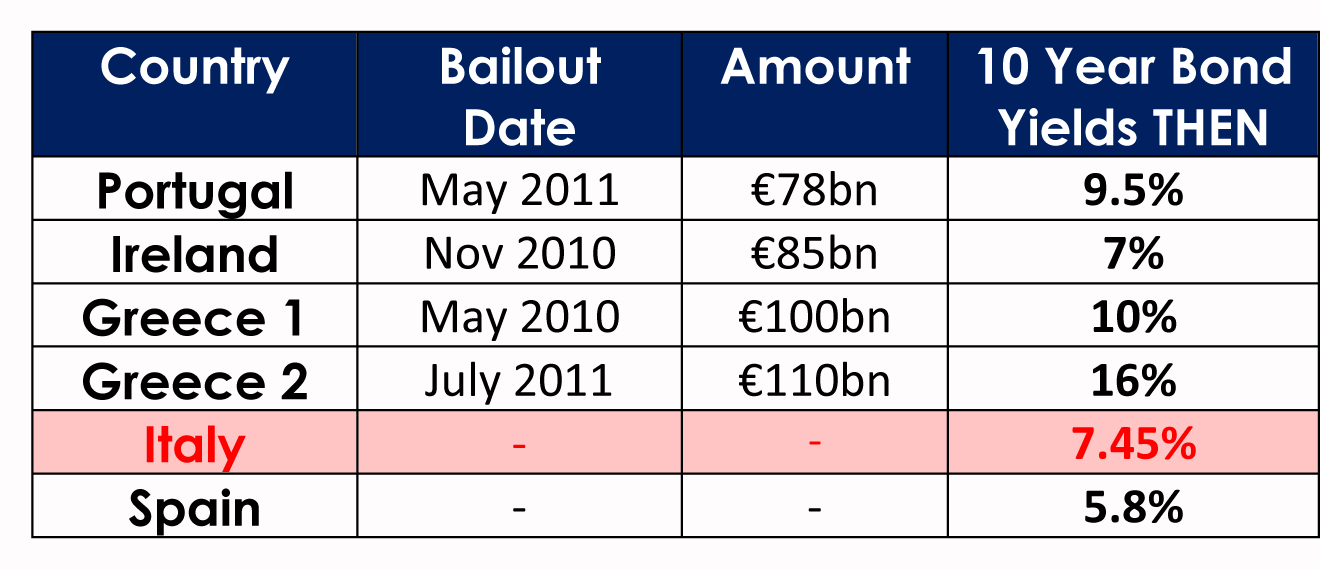
In a previous in-depth PIIGSty musing , we assessed the ‘tipping point’ for requesting EU-IMF bailouts at around 7-10%. This is the danger zone.

How does Italy fare? (November 9, 2011)

You can see why (purely simplistically) why European leaders are starting to get extremely nervous. Italy, with €1.9tn of sovereign debt is over 7.5 times the ‘new’ level of Greek debt of €250bn after the October 27 Agreement. Italy is also ‘too big to rescue’ under the current €440bn EFSF fund. Even with IMF help, Italy appears a bridge too far. Europe has dithered and participating in reactive patchwork decision making and ‘sticking plaster’ solutions for the past 18 months.

Time might have just run out.


Economics 101 (#18) Markets for Factors of Production

November 4, 2011

Whenever you produce a good/service, you need a certain combination of each of the 4 factors of production (FOPs). Some are more labour intensive than others (such as manufacturing). Some are more land intensive (such as farming). Some are more enterprise intensive (such as new technology ideas i.e. IPods).

Heres the PDF PIIGSTY Econ 101 #18 Markets for FOPs