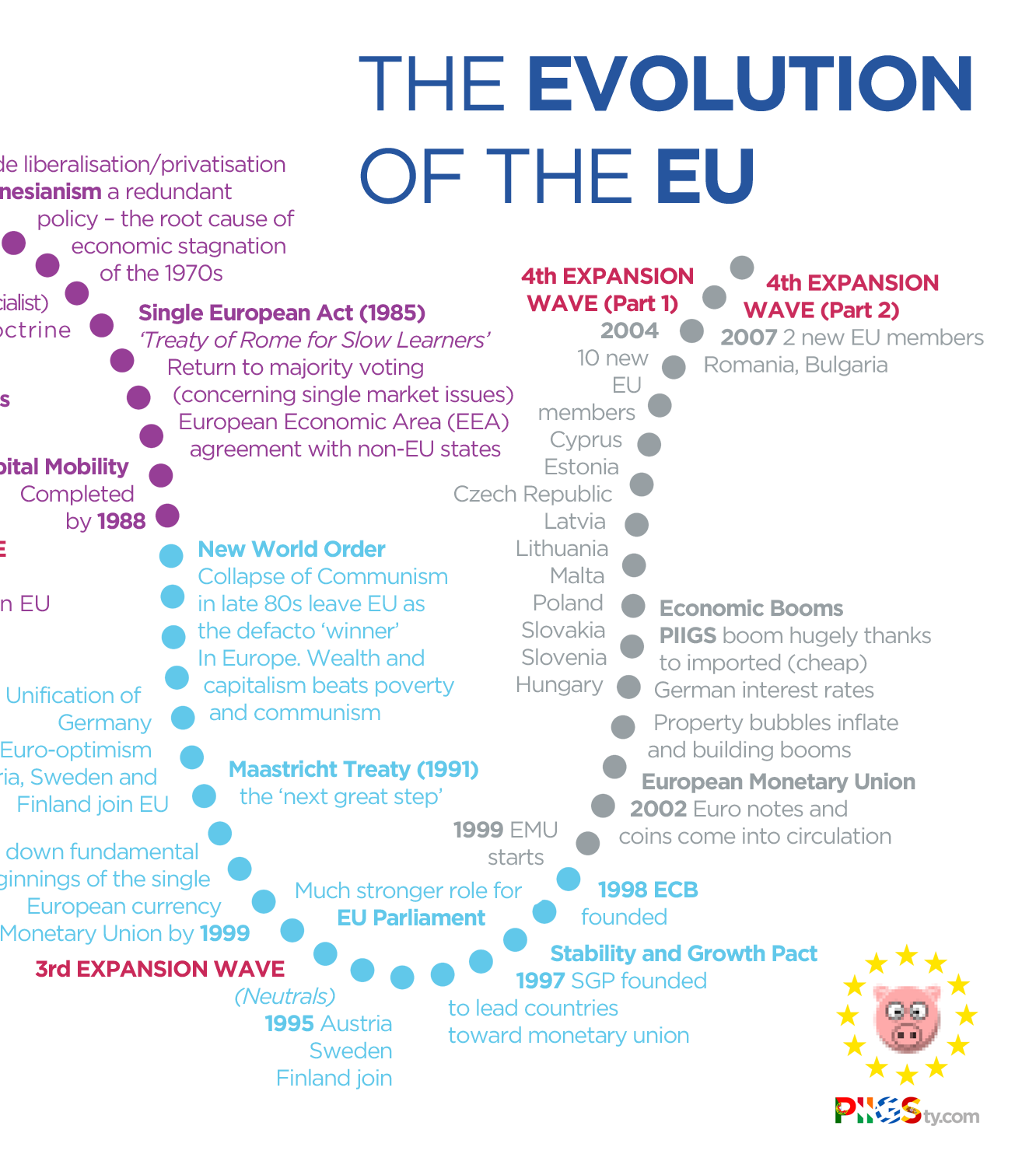
PIIGSty Evolution Series #1: Evolution of the EU

October 4, 2011

Today, PIIGSty proudly presents its first original graphic in a new ‘Evolution’ series on EU issues

Naturally, the subject of our first one is *drumroll*The Evolution of the EU


Download the PDF below (print it and share!)

PIIGSty Evolution #1 Evolution of the EU

Always remember to get in touch with suggestions for future graphics to PIIGSty@gmail.com


The PIIGS 10 Year Bond Problem

October 4, 2011

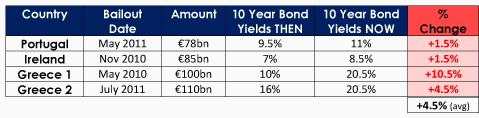
We all know why the PIGs have needed to source temporary financing/bailout funds from the EU-IMF  – it was just too expensive to continue borrowing vital operational funds through the bond markets (the usual route). Think of it this way. When investors (say, big German/French/Belgian/British banks) buy €1bn worth of Greek bonds, they’ll get €1bn back in 10 years + interest @ X%. This X% is the ‘yield’ (premium) to the investor but the ‘excess cost’ to Greece of issuing the debt/bond (i.e Greek borrowing)

Why would the ‘yield/cost’ go up?

  • Investors HATE risk. Risk costs money and risky investments aren’t likely to attract many takers.
  • Greek bonds are VERY risky because with all this talk about haircuts (slicing a chunk off the €1bn principle) to European bank debt in the PIIGS, investors may think that government debt could be next for the chop (in some way or another)
  • Buyers of Greek bonds will need encouragement for taking on more risk i.e a higher premium (a higher X%)
  • This means that investors buying Greek debt will demand more – and Greece will have to pay more. Greece can’t afford to pay more interest because it comes out of the funds that pay for the to day to day running of the Greek economy. Pressure on the flow of that cash could cripple the economy (and, you never know, cause a revolution).
  • So, Greece can’t borrow that way – it needs a bailout from the EU-IMF (or, more specifically, the ‘troika’ – the European Commission (EU), European Central Bank (ECB) and International Monetary Fund (IMF).

Interestingly, for each recipient of EU-IMF aid, the ‘tipping point’ (the cost or bond ‘yield’ at which countries was forced to ask for help) was different.

PIIGSty compares the situation then with the situation now, in October 2011 (approximated and rounded figures via Trading Economics).

On average, prices of 10 year bonds (cost of borrowing the usual way remember) have actually increased (its more expensive) across the three PIGs since the various bailouts were initiated (-4.5%). Greece has deteriorated significantly (obviously, considering the need for a 2nd €110bn bailout in July). Ireland and Portugal have coincidentally declined by approximately equal levels (-1.5%).

The tipping point for the PIGs have proven to be between 7%-10% (Greece 2 being the exceptional case) – this compares with current levels of 5.16% for Spain and 5.41% for Italy (and 1.77% for Germany).


Europe 2011: “An Intergovernmental Event of 26 Men and 1 Woman”

October 4, 2011

Here at PIIGSty.com – the issue of the inadequacy of the EFSF has been long discussed, an issue which has recently reared its ugly head again at meetings of the IMF and G20. We decided to sit back and wait for the hysteria to die down in recent weeks and for clarity to replace hyperbole. Since September 20th, we have learned some key things about the eurozone (EZ) crisis. Heres a run down of some activity in the key players.

Germany

Chancellor Angela Merkel has been triumphantly congratulated on her overwhelming Bundestag vote to expand the borrowing capabilities of the EFSF (as agreed in the July 21 meeting) and rightly so.  The vote also succeeded in stablising her CDU-FDP coalition with a combined 315 votes FOR and only 13 AGAINST) despite huge misgivings, meaning the crossover opposition support from the Social Democrats and Greens wasn’t as critical as some commentators had expected. Of course, the market pleasing 52385 vote victory is bittersweet. First, the good news. The good ship Europe was steadied temporarily and the media outlets ignored the Greek crisis for at least a day. The bad news. That same ship is essentially still hurtling toward the same reef, likely to founder eventually on those sharp (and self chiseled) Athenian rocks. The cannons can sink some foes along the way but the course is set if the wheel isn’t turned.

Why not turn the wheel? Europe is still playing catch up and continues to woefully and frantically follow events rather than lead them. The ‘Merkel wins’ narrative was always going to change. A €440bn EFSF is inadequate and the return to market turmoil in October confirms that. The fact that even a simple enlargement of the fund (which was more procedural than a sign of proactive EZ economic governance) has shown that any future necessary financing of bailouts or bank recapitalisations are just not on. The EZ’s effectiveness to deal with this crisis has now been formally politically neutered.

Germany will ultimately (after all EZ parliaments pass the EFSF reforms) be responsible for nearly 50% of the EFSF fund, around €210bn. The likelihood the ‘Merkel-Schaeuble (her Finance minister)’ doctrine of ‘no more bailout money’ will change beyond that is just implausible and politically suicidal.

Greece

Greece remains the problem child of Europe. Fostered under a European monetary system it never ascribed to wholeheartedly (since the Greeks were never too fond of following the rules of EMU) the Greek-fueled EZ debt crisis remains poised to cause a financial earthquake, especially if its spreads. To say this is only because of the petulance of some myopic Greek politicians isn’t fair but consensual decision making in Athens is proving elusive. Opposition parties are steering clear of the austerity and privatization plans, even objecting openly to the proposed cull of 30,000 public sector workers, despite the costly historical burden this sector represents – currently 45% of the entire Greek economy.

Read the rest of this entry »


Merkel’s Coalition hit with 6th successive election blow

September 20, 2011

As expected, the Berlin (state/city level) elections in Germany did not disappoint analysts seeking to expose Merkel’s shaky CDU-FDP coalition. This time, however, the brunt of the dissatisfaction with the government was felt by the small pro-business Free Democrats (FDP) who have already expressed high level misgivings with voting for EFSF reforms (some going so far as to demand a referendum on the issue).

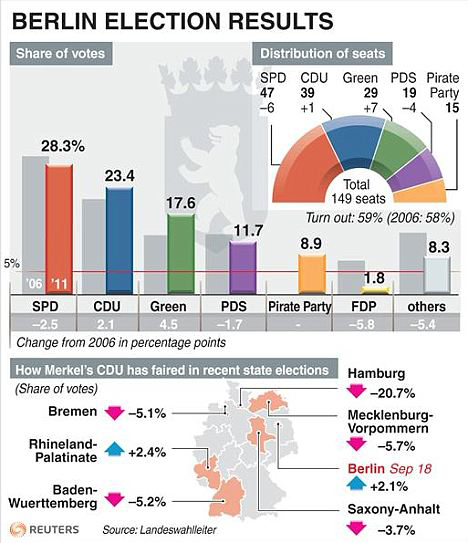
This excellent graphic from Reuters sums up the situation well.

The red 5% line is the minimum level where parties are awarded seats under the proportional election system. In a stunning rebuke to the established political parties, the fast growing Pirate Party won +15 seats in the 149 seat body, a first for the party in the capital. The pro-internet liberalisation party (now branching into a broader electoral platform including education and citizens rights) was not the only winner. Seat gains were recorded for the Green Party +7 (a strong force in German state and federal politics) and Merkel’s party, the Christian Democrats (CDU) +1. The CDU gained gained +2.1% in what is a friendly district historically for them. The main opposition party to Merkel at the federal level, the Social Democrats, suffered losses of -2.5% and -6 seats respectively.

The overall message is symbolically difficult to swallow for the FDP. The electorate are angry and are clearly demanding a reassertion of German civil liberties. From a European standpoint, this bodes ill. It suggests that political populism and a retrenchment to German priorities is an irrestible notion. For the FDP – holding no seats in the district that holds the federal parliament is a damaging blow to the party and may proof to be a destabilising factor too far for a party seeking to reassert itself against its far bigger and increasingly divided coalition partner. With voices condemning Merkels leadership (or lack thereof) becoming increasingly loud and with German and international media increasingly fixated on the potential leadership contenders, the battle wounds are beginning to neuter the abilities of the government to actually achieve anything – especially on Europe. The knock out blow might come sooner than 2013 when the next federal elections are scheduled.

Expect the route toward the September 29th EFSF vote to get slightly rockier. Even if it does torturously pass, the political capital spent by Merkel on keeping her party and coalition together might mean shes fresh out of ammunition. And the hard work for a future fiscally sound Europe hasnt even started.


The Economist on the European Crises (10-17 September)

September 15, 2011

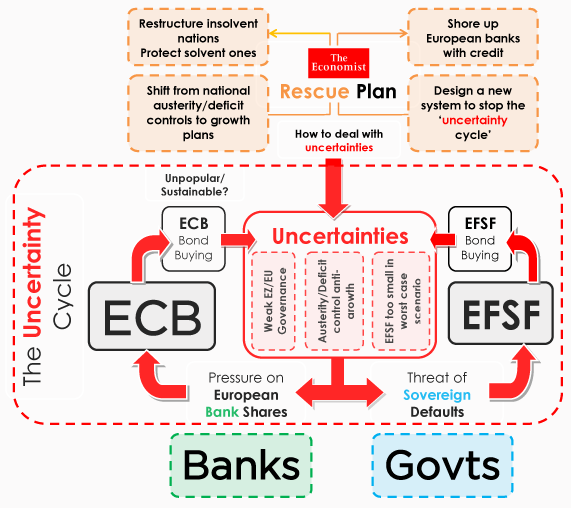
Over the past week, there have been a few really valuable insights from the Economist on the euro crisis and the European debt crisis. Of course, we at PIIGSty are very proud of our summaries so, with you in mind, we’re giving you a run down of our favourite three articles. Heres a PIIGSty pictoral summary of all 3.

Full summaries of the articles are below…

Read the rest of this entry »


The BRICS Bail-out the PIIGS?

September 15, 2011

There is plenty of negativity associated with the present day European project – some of it merited, some not. A key question which is not often asked is ‘what next?’ With the EU’s economic wings pretty firmly clipped for next few years, we are living through an on-going battle. While we look within ourselves and talk about future economic and political governance, what about our external position? Where is Europe’s relevance in the 21st century?

One article which PIIGSty feels represents an interesting tip of the iceberg insight to this question is in today’s Wall Street Journal entitled Emerging Giants Look at Europe Aid’

An alternative headline could be, as one clever commentator puts it ‘BRICS rescue PIIGS.’ The BRICS – Brazil, Russia, India, China and South Africa – are basically an acronym for growth especially considering the various restrictive factors on the traditionally strong US, EU and Japanese economies. The BRICS, in sum, are growing fast in economic importance. But even the BRICS are not immune to a downturn.  Chinese growth forecasts for one have been pared back thanks in part to the EZ crises. Without Europe buying BRIC exports, BRIC economies can overheat. China needs to carve out new markets and as China produces more technologically advanced exports, the best option is to sell them to Europe and North America rather than Africa where it is also trying to get a foothold.

Read the rest of this entry »


Richard Baldwin on ‘Phrase 2 of the Eurozone (EZ) crisis’

September 14, 2011

An excellent article by Richard Baldwin at VoxEU.org from 5 September provides a great overview of the linkage between the various crises gripping the eurozone (EZ) and how we may be entering (or are already in) the next phase of these series of crises. Baldwin illustrates their interconnectivity with a simple diagram which PIIGSty has tidied up for clarity.

The connectivity is as follows:

(A) Lehman Vortex

  • Banks rely on investor and consumer confidence. Without confidence, investors and consumers withdraw their funds and the bank becomes insolvent (unable to fund its day to day operations).
  • When Lehman collapsed on September 15, 2008 – a plague spread rapidly through Wall Street as fast moving investor capital began to flood from (up to then) other steady investment banks
  • This is a self fulfilling prophecy – if investors/consumers believe their bank is about to go bust and their cash to disappear, they will rush to (or ‘run on’) the bank and withdraw. Similarly, interbank lending (banks lending to each other) is likely to completely shut down. Banks can’t access funding – so who do they borrow from?
  • This means that just the fear of solvency freezes long term funding making banks insolvent.

(B) Sovereign & Implicit TBTF ‘Irish’ Vortex

  • Large bank failures and their threatened insolvency, due to their integrated nature of national economies (the body) and banking credit (the blood that circulates) – mean that insolvent banks can cause sovereign insolvency. This requires, as in Irish case, direct funding from the exchequer funded by sovereign debt.
  • The opposite is also true of the PIIGS-Northern European bank relationship – where banks hold PIIGS national debt meaning sovereign insolvency (in the periphery) can cause bank solvency (which causes a cyclical effect and the process repeats). This why ‘burning the bondholders’ in Portugal/ Ireland/Greece really means scorching Northern European commercial banks in Germany, France, Belgium, the Netherlands and others – a potential destabilising factor for otherwise stable economies.

(C) Austerity-Trap Vortex

  • If a nation tries ‘too little too late’ Greek style reactionary austerity policies, it can get caught in an ‘auserity trap’ where stringent cuts lower income levels, depressing tax revenue, raising spending on welfare and ultimately making increased borrowing necessaryworsening deficit/debt levels

(D) Debt Service Vortex

  • Nations spending becomes orientated not toward their taxpayers but toward paying debt levels of a past generation, contributing a significant proportion to exchequer spending.

To end the cycle, the options are pretty sparse, and both are debt laden, politically painful options for the richer EZ members (and aren’t particularly short term solutions either)

  1. Adopt credit debt smashing domestic institutions  i.e. adopt a stringent line on debt
  2. Gift national fiscal policy to a higher coordinated authority via fiscal union

Recession

The bottom line? So long as economies are in recession, these 4 branches/vortexes of the current EZ crisis will continue. Yet we still live in uncertain times with daily warnings of a return to negative growth and the spectre of a double dip recession in many economies. Recessionary fears stoke these 4 branches, injecting uncertainty back into the system in a painful cyclical repetitive process that European leaders seem content to oversee as hand wringing spectators. That is what caused Italy and Spain, as well as French banks and others to head south recently before stabilising again.

When European leaders meet, the panic subsides. Echoing Mr. Baldwin, PIIGSty firmly hopes “[that European leaders] actually get up and put the crisis to bed, rather than hitting the snooze button and heading back to bed themselves.’ Who knows! Maybe the markets are pushing the leaders into action. Lets hope it doesn’t require a real scare.


Return of the Buzzword – Eurobonds

September 14, 2011

In the earlier PIIGSty.com post on ‘Bonds, Bonds and…Eurobonds!’  – the theory underpinning such the drastic jump into European fiscal consolidation was laid out. Continued rumblings over the European debt crisis have seemingly forced  the executive (government) in the EU legislative process (the Commission) to proactively try to jumpstart the spluttering efforts by member states to fix the obvious deficiencies on the EU periphery and by extension to battle the perception of a leadership vacuum in Europe (no small task).

European Commission President Barroso, speaking today in the European Parliament, has announced that time is up for dithering and indecision and has thrown down the gauntlet for other leaders to instill some confidence into the collective European economy. Part of his speech dealt with a reoccuring issue, Eurobonds – which needs more explanation. Heres a quick summary:

  • Commission will present options for the introduction of Eurobonds
  • This will likely require changing existing EU treaties
  • It should be achieved through a Brussels-led ‘community effort’ rather than one led by the Franco-German alliance. Why?
  • The solution to the debt crisis must be supranational not intergovernmental as the latter just continues the failed and myopic fiscal direction of the past
  • Are Eurobonds the best short term solution? Nope. In Barroso’s words  “We must be honest: this will not bring an immediate solution for all the problems we face and it will come as an element of a comprehensive approach to further economic and political integration.”

While Barroso’s speech raises the spectre of Eurobonds again (and all the antagonistic debate that follows between the PIIGS and France/Germany),  Barroso represents a player in Europe which is increasingly subordinated in the pecking order under those with the political and economic brawn to assure and stabilise the markets.

Read the rest of this entry »


Economics 101 (#4) The Consumer

September 11, 2011

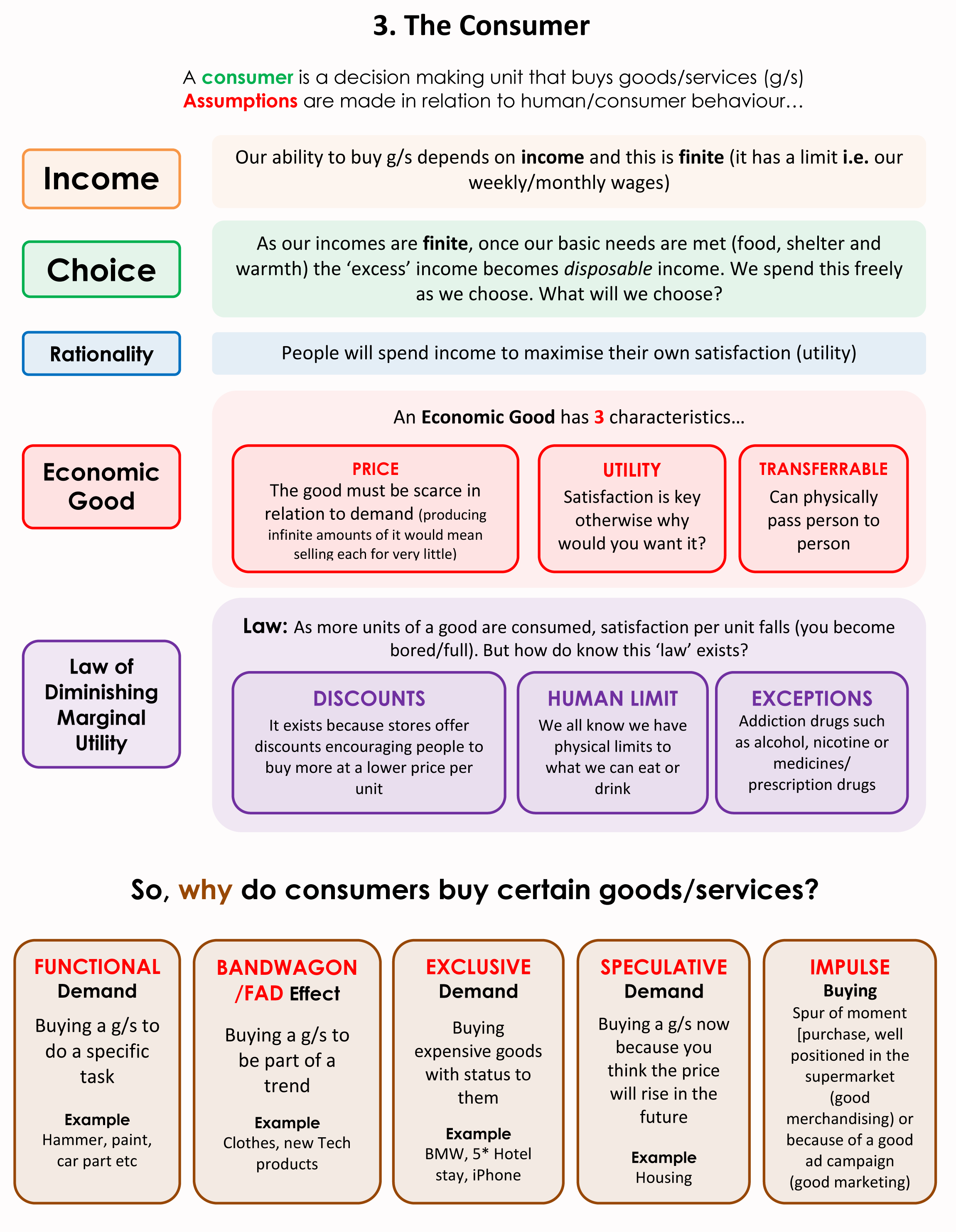
After producers come (you guessed it) consumers! A consumer is a decision making unit that buys goods/services (g/s).

Key assumptions are made in relation to human/consumer behaviour…

Heres the PDF PIIGSTY Econ 101 #3 The Consumer


Is it ‘Merkel for Majority’ over the EFSF reforms (in Germany)?

September 9, 2011

September is proving to be a crucial month for the EU and its biggest player- Germany. A political battle is waging in the German government prior to the formal EFSF reform vote on September 29th on those changes agreed at the EU Summit in July.

Below is the timeline for the month detailing all that info you need to know about what has happened recently and whats coming down the tracks…


Backbencher misgivings stem from a number of issues

  • Questions over the ECB bond buying programme
  • Questions over the Merkel ‘no collateral’ line over bail-outs (after Finland received once-off collateral assurances on 16th August)
  • Regardless of the vote, Merkel’s leadership is coming under strain over accusations of lack of leadership (foreign and domestic)
  • The SPD indicate they might not support the EFSF reforms if it means helping a weak Chancellor cling on to office and prolong the creation of a more stable government

Read the rest of this entry »