The European Money Jar: The EFSF

August 15, 2011

Every article and news report on the European crisis seemed to mention the ‘EFSF’ – the European Financial Stability Fund. What is it and why is it important?

First things first, what is it?

Officially,  Its a triple A-rated eurozone private company run by the European Commission, European Central Bank, IMF and the Eurogroup (eurozone finance ministers). It is backed by guarantees from all 17 eurozone countries (but really, its the guarantees of the 6 AAA ones that matter).  It sells debt/bonds to raise money for bailout funds for countries in need and help them pay their short term debts  (keeping the default wolf from the door). It can also be used by a country to fix their banking sector (as in Ireland). But it cant just intervene. Countries must apply for funds and be accepted (so you better be in trouble because ‘applying’ is enough to make investors run for the hills). So it’s a means to an end – only to be used after euro-using countries cant borrow in the normal way from the markets.

How much is it?

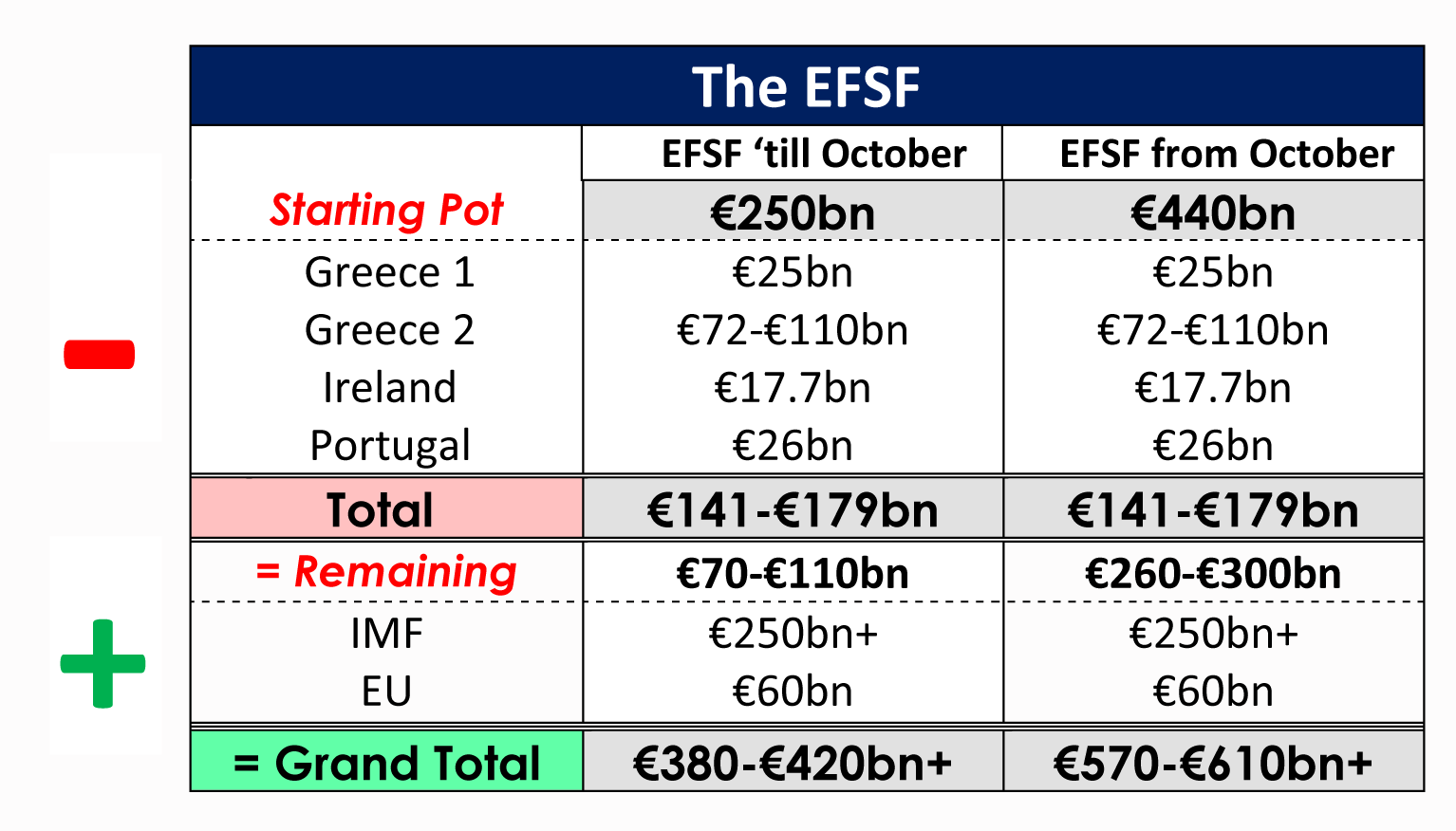
Before reform proposals made in July are agreed, it has a ceiling of €250bn. Of this, €100-€135bn has been pledged to Greece (€25bn for 1st bailout + €72bn-€110bn for 2nd bailout), Ireland (€17.7bn) and Portugal (€26bn).  The July 21 reforms will see its lending ceiling grow to €440bn. Even if the reforms are passed by October across the EU, the pot is already reduced to between €260-€300bn after PIG deductions. If you want to get technical, because EFSF bonds are guaranteed up to 165% of their size, the EFSF crutch  (on remaining funds) is technically between €429-€495bn. In cold hard cash, the overall bailout fund, adding the EU’s €60bn and IMF’s €250bn is now between €570-€610bn.
Read the rest of this entry »


Lesson 5: Printing Money Explained (Part 2)

August 12, 2011

I know, Part 1 was a bit intense. Your reward is some nice and simple diagrams.

First, on the clogs in the banking/financial sector and its effect on the wider economy

PIIGSty Printing Money Explanation 1.1

Second, on the what the government can do to free up the clogs

PIIGSty Printing Money Explanation 1.2


Lesson 4: Printing Money Explained (Part 1)

August 12, 2011

Pay attention ‘cause this is a tricky one. Former Chairman of the US Federal Reserve Alan Greenspan said something very interesting in a recent interview on MSNBC. When asked were US treasuries (US debt) still safe to invest in [coming after the US downgrade by Standard & Poors to AA+], Greenspan repliedVery much so. This is not an issue of credit rating. The United States can pay any debt it has because it can always print money to do that so there is zero probability of default.”

Printing money (aka Quantitative Easing or QE1, QE2 etc in the US) conjures up images of ropey old monetary dinosaurs, eyes bulging as giant money presses spit out endless dollars, euros, yen , yuan or what have you. In the electronic age, luckily you don’t actually have to physically roll out legal tender paper and print away to your hearts content (at least, not in a civilised economy). Instead, you can use a trick of accounting to simply write in €10bn, €20bn, €100bn…onto the ‘asset’ side of the Central Bank balance sheet (or in the ECB case, the balance sheet for the eurozone-17).

The hope is that printing money will spark economic growth or inflation or both. Why? Well think of this. Every economy consists of goods and services – that’s what we produce. If that’s what we produce, then surely measuring money – what we spend on that stuff – is measuring how the economy is doing. Which it does.

Economic growth then (the change in output year on year) must = the amount of money in the economy (supply)  X  the speed its sloshing around (velocity).

Today, the speed (velocity) has dropped to a standstill. But, each Central Bank can increase the supply! How?

  1. Lower interest rates (make existing money ‘cheaper’)
  2. Print money (make more money)

Read the rest of this entry »


Michael Lewis on Germany

August 10, 2011

Michael Lewis of Vanity Fair is no stranger to Europe.

  • In April 2009, Lewis published ‘Wall Street on the Tundra an article tracing the logic behind the economic meltdown in Iceland.
  • In October 2010, Lewis followed this up with a study into Greece in an article entitled ‘Beware of Greeks Bearing Bonds.’
  • In March 2011 Lewis made waves in Irish political circles (an article published in the March edition of VF but available during the final calamitous days of the Cowen government) with his devastating insight into the banking and political upheavals in Ireland with his ‘When Irish Eyes are Crying.’

In the September 2011 issue of VF, Lewis has focused on Germany – EU lender of last resort and lynchpin of the euro – in an article entitledIt’s the Economy, Dummkopf!’

Heres your summary…

Lewis begins with a valuable insight into the German character – something with has an historical affiliation with…well….’faecal matter.’ From bizarre childhood folklore tales and Gutenberg’s strange choice for his 2nd printing to Martin Luther’s ‘scatological’ original idioms and Hitler sexual desires–a key German character trait is an obsession with waste or at least, taking dirt and cleanliness in equal measure – an affliction deeply ingrained but hidden within.

The article pivots into more analytical territory with a reference to sobering and contrasting statistics. Greece unemployment at 16.2% versus a 20-year low German rate of 6.9%. A job in Germany which pays €55,000 pa, pays €70,000 in Greece – effectively two extra monthly payments. Greece is plaqued by debt and deficits – with the euro like a inverse gastric band meaning the binge cannot stop. Greece, according to Germans, have two choices. Slim down government (and sacrifice growth) and fiscally integrate into Europe or reform how Greeks work and make the Greek people…Germans…with all the efficiency and productivity that goes along with that stereotype. Economically, the only solution is for German to stop bitching, arguing and hoping and just write the cheque. Politically, this isn’t a runner for Merkel. So, Europe trundles on, with regular crises (as in Spain and Italy recently and soon in Cyprus and France) meaning stop gap sticking plaster solutions that solve nothing.

Read the rest of this entry »


The Irish Debt Worst Case Scenario

August 9, 2011

One often forgotten element to the massive debt pile Ireland must pay is the overall interest payments we must fork out each year. Ireland has two dual problems. The first is a sovereign debt crisis (which requires cash transfers from the EU-IMF in return for austerity programmes promising to restrain spending). The second is a banking crisis (which requires government guaranteeing major banks and paying bank debt in full to get the credit market flowing again without heavy penalties).

Here are the figures:

Potentially, the worse case scenario here would mean approximately €12bn in annual interest payments by 2012. For perspective, this would represent 85% of the entire 2010 income tax revenue.


The Great Economist Debate: Keynes or Hayek?

August 9, 2011

If you need to know about only two men on the planet earth at this moment – these are the two.  John Maynard Keynes and Friedrich Hayek are two greater economic thinkers of the 20th century. More interestingly, their views are polar opposites in economic theory…

So what are these two guys talking about?

Keynes

Keynes adopts a ‘Top Down’ liberal approach. According to Keynes “in the long run, we’re all dead” – so we can’t wait on market forces to gradually turn the economy around. Government spending (stimulus packages) can create employment and growth in the economy in a recession/’bust’. Booms usually mean that interest rates are low when a bust hits (because booms usually slow before a bust…so authorities try to keep boom going by lowering interest rates).  The rates are then kept artificially lower by an expansion of cheap credit/easy money. Lowering them further won’t stir enough activity to keep demand up (Liquidity trap). Some demand might come from savings, so people shouldn’t hoard money away, they need to spend it!

Read the rest of this entry »


Lesson 3: Best in Class (Creditworthiness in the eurozone)

August 5, 2011

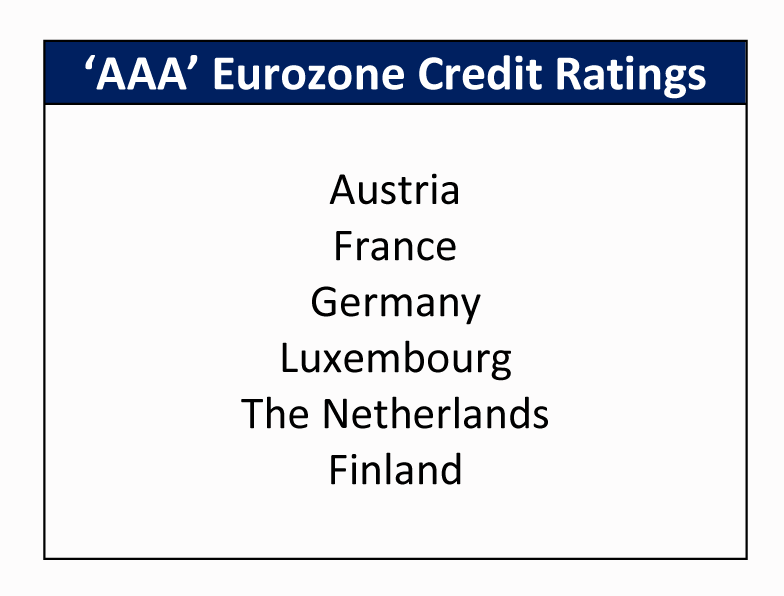
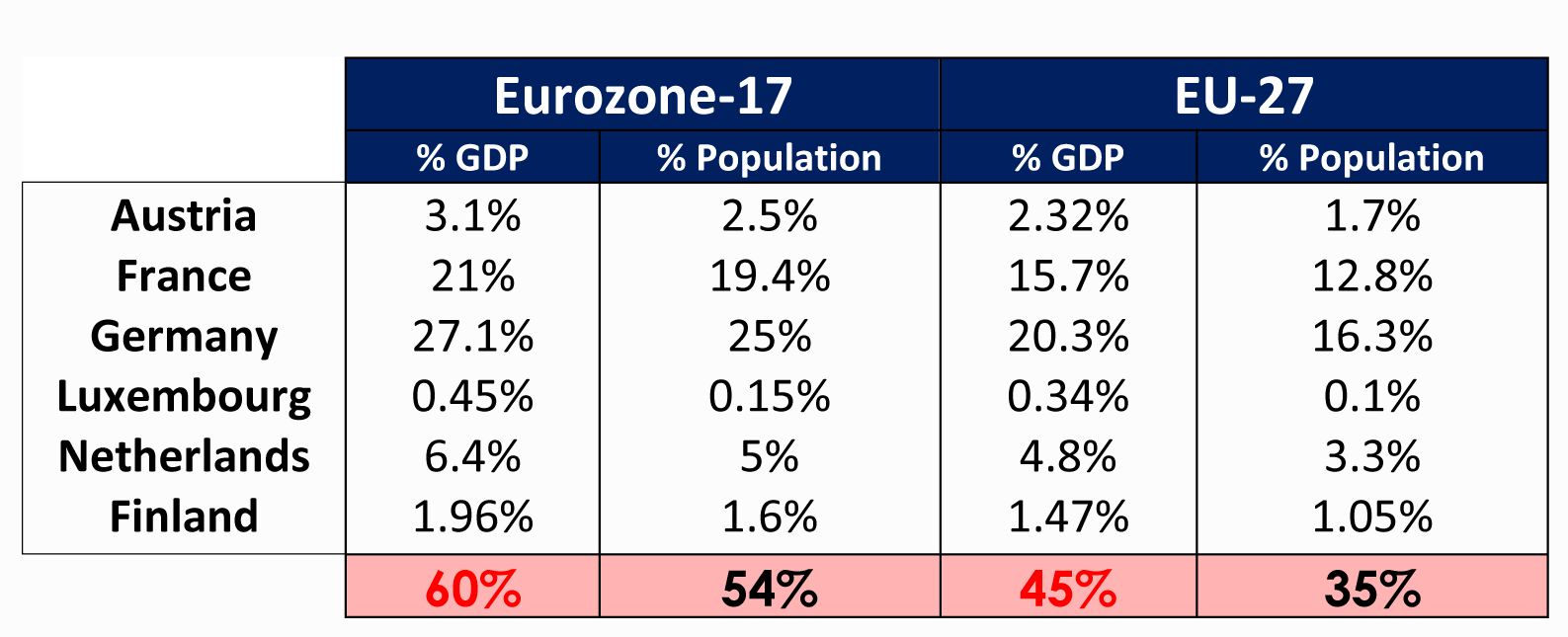
The borrowing rate on the European bail-out fund (the €440bn EFSF fund) is less than 3% . The reason is that If all 17 eurozone nations worked together and borrowed money as a group, then the weight of the larger and more creditworthy among them would mean a lower borrowing rate (interest rate). Six eurozone members have excellent AAA credit ratings (including the EU giants France and Germany) and they therefore borrow at a lower rate than the much smaller, high debt nations like Greece or Ireland.

These AAA eurozone nations represent a big chunk of the EZ-17 (in population and GDP terms) and a sizable chunk of the EU-27 too..


Of course, this means that smaller eurozone countries ‘piggyback’ on much bigger nations credit rating to solve their own problems which isn’t viewed as very fair if the bigger countries have to then pay a higher interest rate collectively than they would have on their own. This is why French President Sarkozy and German Chancellor Merkel constantly have to walk a politically delicate tightrope to get agreement on any united European effort.


Lesson 2: Can We Ditch the Euro?

August 5, 2011

One way to speed up the balancing of the PIIGS finances (to get some credibility back from the markets, remember!) is to reduce the value of your currency or break away from a bigger currency and set up a new one.  As euro-members, eurozone (EZ) countries can’t fiddle around with the value of their currencies which they could before i.e. making their currencies cheaper so others buy more of what you produce and drive up demand for your exports, businesses and jobs.

This means EZ countries can’t just break off from the euro and set up a new currency for themselves (or an old currency; i.e. bring back the Punt, Escudo, Drachma etc). Put simply, it would set alarm bells ringing for investors who suddenly realize that you’ve given up a currency anchored in ECB HQ (and politically in Berlin and Paris) for one anchored in Dublin, Athens, Lisbon, Madrid or Rome… places where the fantastic decisions were made that put the PIIGS in the giant mess in the first place. In any event, it mightn’t make any difference to the big problem – the national/sovereign debt piles. Lets say Ireland wants to restablish the Punt. Heres the pros and cons.

Like during any real disaster, some are more concerned with arguing that the eurozone led itself into this mess in the first place by having a lax attitude toward the entrance requirements (the Maastricht Criteria) and lax regulation (the Stability and Growth pact) rather than addressing how to fix the problem.  Current debt levels force countries to make the hard choices in other areas, such as the main government account deficit by cutting public spending and increasing debt. There is, obviously, a limit.

With so much uncertainty, the only real credible elemnt the PIIGS are clasping onto for dear life is the euro and ECB control of monetary policy. German leadership (of the euro) means shrewd German policies – and the markets like these. But it was never envisioned that we’d have a banking crisis on top of deep fiscal crises in previously sound economies. An obvious altternative solution would be to temporarily suspend debt repayment to certain parties (i.e. certain bondholders) and only pay those who need to be paid – but this brings challenges to those big Northern European banks who own PIIGS debt.

So, no. You can’t scrap the euro. It would put a gun to your own head and giving the ability to pull the trigger to millions of unknown people. Your debt pile remains – in Punts, in euros, in golden coins, in lumps of coal – whatever unit of value you want. You still owe it. The only correct action is to fix the pile – and this is Europes challenge. One way or another.


A Long Dark Tunnel

August 5, 2011

Looking at the current state of the Atlantic economy, its pretty clear things are not going well.

On Thursday, 4 August 2011 – European markets fell sharply, the FTSE falling nearly -3.5% and the Dow Jones stock exchange falling 512 points (-4.3%). These are late 2008-early 2009 levels (the height of panicky season). Lets have a look at the key factors:

Americans Leading by Example

The US federal debt ceiling-fiscal austerity hybrid package which President Obama signed at the last minute on 2 August saw a simple procedural task do a depressing level of damage. The hugely fractious debate highlighted deep fissures at the political level with two distinct (and polar opposite) economic viewpoints dramatically colliding (one favours drastic cuts to federal spending, the other favours a streamlined but strong federal role). The perception that Republicans and Democrats are ideologically at war makes a compromise US economic strategy (on the only issue that really matters – jobs) now increasingly unlikely (if not utterly impossible) in the politically charged atmosphere running up to the Presidential election in November 2012. This, on top of dwindling consumer spending means the new austerity plan to slash public spending while the economy hovers above recession might be a heavy handed action at the wrong time. The likely result may be the feared ‘double-dip recession’ as investors run for the hills and seek short term gains in emerging economies, returning after the election (fingers crossed).

The other PIIGS – Italy and Spain

In the rank of worlds largest economies  – Spain is 8th, Italy is 12th. The markets/investors know all too well that whatever sticking plasters EU leaders conjure up, the EU-27 (including the eurozone-17) need to convince the market they’re serious about the problems and ready to solve them (a trait currently lacking). Something with economic teeth is urgently needed, backed up with far more cash and political solidarity than leaders have yet mustered. The figures do not tell a simple story. Spain has 20% unemployment with over 40% youth unemployment but has a very reasonable debt to GDP ratio (total output) of 75%. Italy has 8% unemployment with 28% youth unemployment with a severe debt to GDP ratio of 119% (2nd only to Greece).

Read the rest of this entry »


Lesson 1: Whats a Bondholder?

August 4, 2011

Fact: The European banking sector is sick. Once a vibrant area bursting with credit, now you’d be lucky to get your credit card application approved. The problem with banking is that the sector is the lubricant ‘oil’ that makes the economic ‘engine’ work. Without it, your economy is sunk. Across Europe, one of the most overused (and misunderstood) phrases these days is ‘burning the bondholders.’ What exactly does this mean?

In banks, there are three groups:

  1. Shareholders – the ‘big wigs’ + guys usually throwing the eggs at AGMs/EGMs who own part of the bank
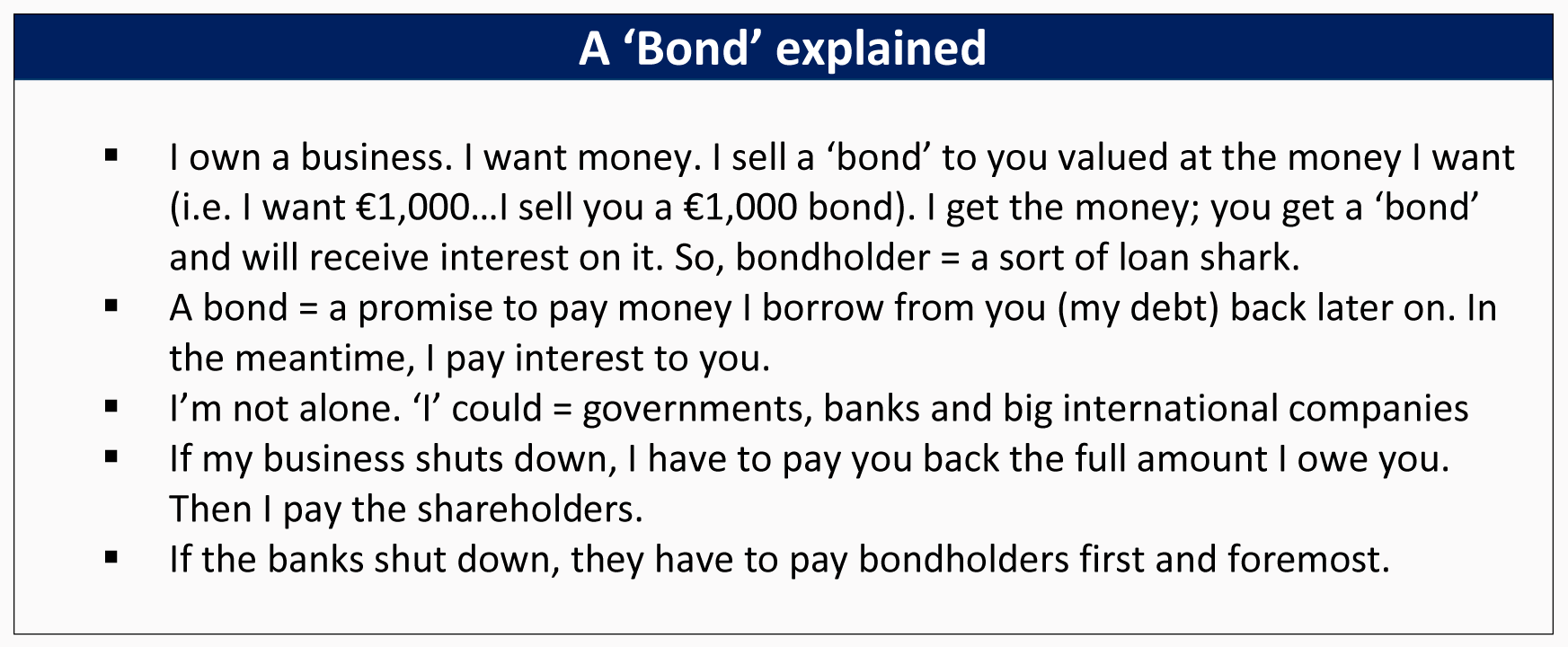
  2. Bondholders (shareholders with less risk) – usually giant hedge funds or other big European banks, less likely to throw eggs
  3. Depositors – the average Joe/Josephine with a bank account

Lets use Ireland as an example. Irish banks need investors. Since Ireland is so small, it needs international investors from across Europe, Asia, the US and beyond.  A bank is unique in that it has both shareholders (i.e. receive % of profits each year) and bondholders (which are like super-shareholders as they get paid interest payments and are paid first if the bank goes bust and is sold off).

As strange as it seems, bondholders are treated like depositors under Irish financial law (which is based on English law) meaning that you could have €1 in your bank account or own €1m of bank bonds and be protected under our big bank guarantee. BUT bondholders can’t run. They have to wait to be paid their €80bn+. Depositors can run, hence the long queues on TV of people trying to withdraw their cash. If Ireland doesn’t pay the bondholders, who are affected?

Read the rest of this entry »